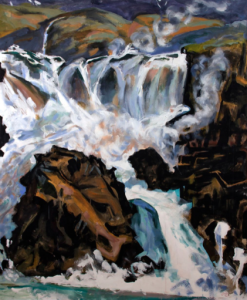
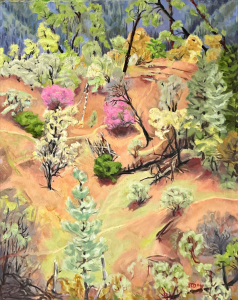
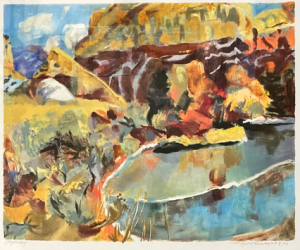
On the occasion of an exhibition of Jolleyn's work at the Zillman Art Museum, University of Maine, our art advisory Rose Fredrick was asked to give a talk. The following is the talk she prepared and delivered on February 5, 2025.
Joellyn Duesberry convinces us of nature’s sufficiency, that we are not impoverished or abandoned. It is an important theme that rules out fashionable distractions: irony is of no more interest to this artist than it was to the psalmists… The achievement in Joellyn’s work is nothing less than to bring us back to life from our inattention. This is art the way it should be—conductive to wonder, open to hope.
-Robert Adams, photographer, author


Joellyn Duesberry, 1944-2016, was 72 years old when she died after battling with pancreatic cancer. That was her fifth and final bout with cancer. Weeks before she passed, I stopped by to see her. She looked ethereal, serene—not at all like the driven, sometimes manic firebrand I’d met when I first moved to Denver and got a job in the gallery that represented her. She usually had this sense about her—like she was in this self-portrait. That day, I told her how lovey she appeared, and she told me that she stepped off the train; she was letting it leave without her, and it felt so nice to just stop.
Years later, in 2021, I was contacted by Joly’s stepdaughters, Rebekah and Jessica Kowal. They were trying to figure out what to do with the more than 2,000 works of art Joly left behind. They didn’t know where to start but they had promised Joly they would keep her name alive by placing important works in museum, public, and private collections. My job has been to catalogue and rationalize all that work—oils, drawing, watercolors, monotypes, and etchings. It was daunting but, three years later, I am happy to report that hundred pieces of art are now in museums, including right here at the Zillman, and in public collections such as The Nature Conservancy and The Dutchess County Land Trust, as well as in private collections. To date, there are only about 500 works of art left.
Knowing Joellyn Duesberry Through Her Paintings
Because I published the book on Joly’s life’s work, I thought I was well-versed in her art and her journey. I clearly overestimated my understanding and underestimated Joly. After cataloging and handling every piece of art left after she passed, I can say with authority that Joellyn Duesberry was a gifted and underappreciated artist and a true force of nature. I believe what drove her was a desire to prove wrong all those who told her she couldn’t be an artist or that she wasn’t good enough and that, after numerous bouts with cancer, her days were numbered so, why bother?
“Because illness sharpens your focus and makes you crave that next step, that next epic, as it were, you have to be more honest,” Joly said in the film, Dialogue with the Artist. “And the more compassionate you are about yourself, about your past flaws and your weaknesses, then you begin to incorporate it and celebrate it.”

Looking back, I think Joly was on the verge of another break-through in painting; she died too soon. There are so many things I want to tell you about Joly, but that would take hours—maybe days—so I’ve decided to tell you about how her life, hardships and joys, travel, friendships, and curiosity that made her such a brilliant artist. I won’t bother with a survey of her drawings, paintings, and monotypes, explaining how she got from ‘A’ to ‘B’, but instead will—if I do this right—show you where Joly lives in these works and how to see and hear her journey because it is woven into the paint and brushstrokes of everything she created.
Quick Facts
Born in Richmond, Virginia, she graduated from Smith College in 1966 and worked as an art appraiser during the day, went to art classes in New York City at night and weekends. At this time, she lived on Great Jones Street in New Work, not far from Andy Warhol’s Factory. She and some of her artist friends were squatters in a cold water flat. Joly was part of the fashion scene—she was beautiful and quite striking. She called herself an autodidact.

Joly said she was a self-taught artist who learned through hard work, drawing sessions, observation, and handling a wide variety of works of art as an appraiser. Because she lived in NYC, she painted the city: buildings, doors, walls, windows—she was drawn to the geometry of the city—any city.

Everything Changes

Then she took a trip to Peru and everything changed. She was swept away by the land and the high views overlooking never-ending valleys. She heard her calling and began to paint landscapes, a subject she pursued until she died. “I did about 120 watercolors–all stolen in Lima, which is sad but just as well because the memory is so sweet. I came back from Peru and I just started painting landscape–it was that easy.”

The Year of Wonder
1986 was Joly’s year of wonder. Two years prior, she had met Ira Kowal, a doctor, musician, bibliophile, and pilot; they married in 1986. Joly moved west to Denver and began dividing her time between Colorado and Millbrook, where she had a home. The Western landscape and dry arid climate opened a new way of seeing and experiencing the land and responding in paint. Together she and Ira flew all over the West, primarily in Colorado, New Mexico, and Wyoming.
As monumental as her marriage to Ira was, a one-month workshop with Richard Diebenkorn rivaled its impact on her life. Joly spent a month working with Diebenkorn. She said he gave her three ideas she embraced from that point on: 1. abstraction and representation are indistinguishable in painting; 2. her need to paint landscape masquerading as abstraction or the abstract masquerading as landscape was emotionally and stylistically unique because she had not been formally trained; and, 3. her need to compose those landscapes probably lay buried in her unconscious displacement of early childhood bliss and terror.

What I Haven't Told You
Diebenkorn’s comment cut to the heart of the matter. Here’s what I haven’t already told you that it important to understand about Joly and her art. Joly’s home life was fraught, abusive and at times, terrifying. Her mother was an alcoholic, and her father was frequently absent. Her mother discouraged her desire to make art. When Joly was five years old, her grandmother, however, bought her first set of oil paints and brushes. Joly had developed a stutter when she was quite young, possibly in response to the abusive treatment she received. When she was 12, she studied French as part of the therapy to overcome her stutter and she became fluent.
Joly suffered from depression all her life, and she could be manic and irrational. Making art, I believe, saved her life. She poured all her energy into it. Richard Diebenkorn was revolutionary in her life, I think, because he recognized her true nature and the pain her art flowed out of. And though he shared insights and encouraged all eight students in the class, for Joly, he validated her every wish and dream since she was a child: to be an artist.
Diebenkorn's Suggestion
Diebenkorn also suggested she try monotypes; this also greatly contributed to her evolution as a painter. “Monotype,” Joly said, “is a means to an end, not an end itself. It forces me to reduce to the absolute irreducible gesture a lot of detail that I end up doing in painting. It’s gooey, it’s fun, it’s urgent; I’m hobbled by the materials with which I can make a monotype.”

She would schedule several days in the winter, usually, with master printer Mark Lunning to just make monotypes. She used the monotype process to solve problems. She said, “If it’s a different scale—and it always is—then I can go back to a painting that hasn’t been finished and really understand what I was attracted to in the original motif. And I can get at it better—the simplicity of it. There’s a huge difference between necessity and embellishment. What monotype tends to do is reduce my reliance on embellishment.”
World Trade Center Residency
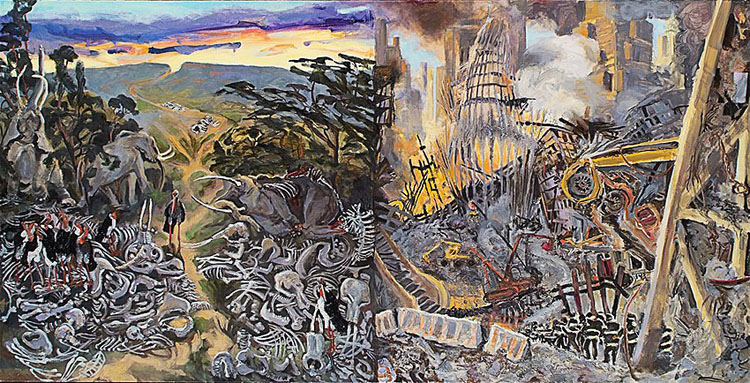
Joly had an artist residency in the World Trade Center on the 91st floor. She create many paintings and brought back photographs from which she created more paintings and many monotypes. A week later, planes were flown into the towers. The artist who started the residency in the Trade Center after her died in the Tower.
Like everyone else in America, she was forever changed by that day. She said, “Days after I witnessed the destruction of 9/11, I visited Kenya (and an elephant graveyard) where I realized that, like the thousands who perished in New York City, the matriarch’s death occurred under shining blue skies. Both tragedies were profound lessons in mortality. It came to me, as both paintings developed, that ritual is dead. We stand amazed by the time and care and deep connection of one elephant to its herd and to the remains of the individual elephants who preceded its herd. But shouldn’t we less startled by, and more emulative of, these animal reverences?”
What We Leave Behind
Joly died in 2016, resigned and yet with so much more painting to pursue. Not only did she leave a profound mark on American art, but she created a body of work that doesn’t tell us how to look at nature but encourages us to look inward for answers.
Karen Wilkin, NY-based art critic and independent curator summed it up best when she wrote: Joellyn Duesberry asks herself questions about what draws her to a particular motif, seeking roots in her own early experiences and memories for why certain places and configurations seem resonant to her. The answers to these questions remain private, but the layers of personal history somehow inform her best work…when Duesberry’s paintings really succeed, they encourage us to bring our own accumulated emotional baggage to an apparently emotionally unfreighted image. [Her] paintings are quiet but surprising; for all their modesty and apparent frankness, they are often far more than the sum of their parts.
I think that she believed in herself as a human being on this earth and she wanted to leave behind a statement of her presence on this earth. She was determined to be remembered as an artist. I think that energy moved her: she wanted to make her statement that she had been here.
-Ira Kowal, Joly’s husband